Archive
Interview with journalist Paul McKay about pipeline economics in Canada
Time and time again, we hear from politicians that we need more pipelines to get Alberta’s oil to new markets. But Paul Mckay, an award-winning journalist who has looked at this issue closely, says this is all a shell game, smoke and mirrors designed to distract us from what’s really going on. McKay says the economics of new oil sands pipelines simply don’t make sense in today’s world, particularly if we have any hope of reducing our carbon emissions.
Paul McKay is an award-winning investigative reporter and author. His reports have been published by the Ottawa Citizen, Toronto Star, Globe and Mail, and Vancouver Sun. He recently wrote a series of articles for The Energy Mix about the faulty economic logic of Canadian oil sands exports called ‘Out of the Loop’.
Earthgauge Radio – April 17, 2018
Edition #14 of Earthgauge News for the week of April 16, 2018.
A weekly Canadian environmental news podcast featuring stories from across Canada and around the world.
Join me here every week or subscribe to the podcast.
On the show this week:
- Palm oil is being banned by a major UK supermarket
- The 2 degrees global warming target won’t hold off climate change
- Costa Rica’s new president vows emancipation from dirty transport
- New Zealand bans oil and gas exploration
- The premiers of Alberta and BC meet with PM Trudeau to discuss the Kinder Morgan Transmountain pipeline while the Keystone pipeline in the US bursts and spills
- Oil drilling is approved in a marine protected area in Newfoundland.
Also on the show this week, feature interviews with Clair Brown, a Professor of Economics at the University of California, Berkeley and the author of the book Buddhist Economics: An Enlightened Approach to the Dismal Science and Kevin Taft, former politician and author of Oil’s Deep State: how the petroleum industry undermines democracy and stops action on global warming.
Earthgauge News – Dec. 4, 2017
Edition #7 of the Earthgauge News podcast for the week of Dec. 4, 2017.
A weekly Canadian environmental news podcast featuring stories from across Canada and around the world.
Join me here every week or subscribe in iTunes or your favourite podcast catcher.
On the show this week:
- Global carbon emissions on the rise again
- Oil drilling in the Alaska National Wildlife Refuge
- Ice apocalypse in Antarctica
- Fossil fuel divestment
- Canada signs high Arctic commercial fishing ban
- Canada and the U.S. failing to protect the Great Lakes
Earthgauge News – Oct. 23, 2017
Edition #3 of the new Earthgauge News podcast for the week of Oct. 23, 2017.
A weekly Canadian environmental news podcast featuring the top stories from across Canada and around the world.
Join me here every Monday or subscribe in iTunes or your favourite podcast catcher.
‘Climate Change: Which way out?’ with Naomi Klein, Bill McKibben, Chris Hedges, Bernie Sanders, Kshama Sawant
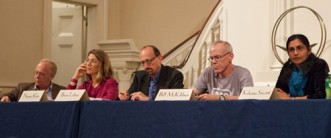
From left: Chris Hedges, Naomi Klein, Brian Lehrer (moderator), Bill McKibben, Kshama Sawant
I was fortunate to attend the largest climate change march in history on September 21, 2014 in New York City. It was an incredible experience to see roughly 400,000 in the streets demanding urgent action on the climate crisis.
The night before the event, there was a great panel discussion featuring Naomi Klein (author of ‘This Changes Everything: Capitalism vs. the Climate’), Bill McKibben (founder of 350.org), Chris Hedges (author and former New York Times correspondent), U.S. Senator Bernie Sanders, and Kshama Sawant (newly elected socialist councilor in Seattle who helped implement a $15/hr minimum wage in the city). It was an incredible night and the atmosphere at the All Souls Unitarian Universalist Church in Manhattan was electric, as you will hear.
Below are the speeches of the five panelists speaking on September 20, 2014 in New York:
Bernie Sanders – U.S. Senator from Vermont
[audio https://earthgauge.files.wordpress.com/2014/11/berniesanders-sept20-2014.mp3]—
Bill McKibben – author, activist and co-founder of 350.org
[audio https://earthgauge.files.wordpress.com/2014/11/billmckibben-nyc-sept20-2014.mp3]—
Naomi Klein – journalist and author of ‘This Changes Everything: Capitalism vs. The Climate’
[audio https://earthgauge.files.wordpress.com/2014/11/naomiklein-nyc-sept20-2014.mp3]—
Chris Hedges – author and former war correspondent for the New York Times
[audio https://earthgauge.files.wordpress.com/2014/11/chrishedges-nyc-sept20-2014.mp3]—
Kshama Sawant – Seattle city counselor
[audio https://earthgauge.files.wordpress.com/2014/11/kshamasawant-nyc-sept20-2014.mp3]
Earthgauge wins 2013 National Community Radio award!
I am thrilled to announce that I was recently awarded a 2013 National Community Radio Association (NCRA) award as the best Current Affairs / Magazine show for my coverage of the Forward on Climate rally in Washington D.C. in February of this year. Click the audio player above to hear a 10-minute sample of the program or click the link below to listen to the full one-hour show.
This show featured speeches and interviews from the huge demonstration in which roughly 40-50,000 people gathered on Washington’s national mall to urge President Obama to follow through on the commitments he made during his inaugural address in January to respond to the climate change crisis. This included speeches by Van Jones of Rebuild the Dream, Bill McKibben of 350.org, Michael Brune, executive director of the U.S. Sierra Club, and Jacquie Thomas of the Saik’uz First Nation in B.C., and interviews from the rally with Michael Brune and Canadian author/ activist Naomi Klein.
Click here to check out Earthgauge’s award-winning coverage of ‘Forward on Climate!’
EG Radio May 9: the Kalamazoo River oil spill 3 years later

Photograph: State of Michigan
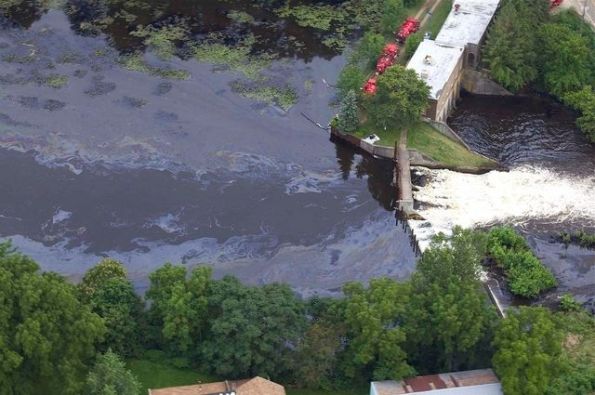
This week on Earthgauge, we take a look back at what happened in Michigan in 2010 when an Enbridge pipeline ruptured spilling roughly 1 million gallons of oil into the Kalamazoo River. What is the legacy of the spill and is there anything for the rest of us to learn as we debate the construction of more pipelines from the tar sands of Alberta to B.C. and the Gulf of Mexico?
I have 3 interviews on the program today:
- Susan Connelly, a local resident of Marshall, MI where the spill occurred
- Jeff Insko, founder of the Line 6B citizen’s blog, a web site for residents who have pipelines running directly beneath their property
- Josh Mogerman, spokesperson for the Natural Resources Defence Council
We’ll also have our usual update from Kathy of Ecology Ottawa on local environmental events and campaigns.
Click the audio player above to stream the show or right click here to download.
Thanks to a fellowship from the Institute for Journalism and Natural Resources, I had the opportunity to travel to Kalamazoo and the surrounding area last week to learn about the Kalamazoo River and, in particular, the Enbridge oil spill of 2010.
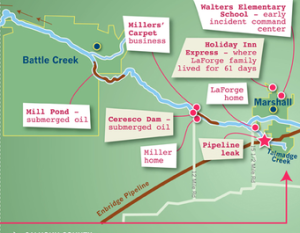
On Sunday, July 25, 2010, Enbridge Line 6B ruptured near Marshall, Mich. and released more than one million gallons of tar sands diluted bitumen into Talmadge Creek and the Kalamazoo River. Illustration by Catherine Mann for InsideClimate News.
Remember that one? It happened on July 25 just a couple weeks after BP finally sealed their leak in the Gulf of Mexico following the explosion of the Deep Water horizon oil rig that killed 11 workers.
Six inches of rain fell in the days after the Enbridge pipeline spill, raising Talmadge Creek and the Kalamazoo River into “a roiling brown torrent that overflowed its banks by several feet,” according to the seven-month, Pulitzer prize-winning investigation conducted by InsideClimate News. Talmadge Creek, which is usually five to six feet wide and a foot deep, stretched 100-feet wide after the downpour.
The spill occurred in Marshall, a community of 7,400 in southwestern Michigan. It drove 150 families permanently from their homes, yet the media spotlight never settled on their story — perhaps in part because this spill occurred 10 days after BP Plc’s Macondo well was finally capped after three months of spewing oil into the Gulf of Mexico.
Enbridge Energy Partners, a U.S. affiliate of Enbridge Inc., operated the pipeline. The company has spent more than $765 million cleaning up the spill.
Oiled sections of the Kalamazoo River reopened to the public in June 2012 — 23 months after the spill.

Photograph: State of Michigan
On today’s special show, we hear a couple different perspectives from residents who have been affected by the spill and its aftermath. First up is Susan Connelly, a local resident who was living near the oil spill when it occurred. Her kids daycare was just a half mile away so she tells us about some of the health effects her family and her community suffered immediately following the spill and in the intervening 3 years.
Susan Connelly (right click here to download):
Next we hear from another local resident Jeff Insko who started the Line 6B citizen’s blog. After the rupture of the pipeline known as line 6B, Enbridge decided to replace a huge section of pipe through Michigan, some of which runs through the property of local residents. Jeff will tell us why he has been less than satisfied in his dealings with Enbridge as they exercised their legal authority to do dig up his property and cut down all his trees in order to install new pipe. Will his experience be echoed by many other property owners as new pipelines are constructed in the coming years across North America?
Jeff Insko (right click here to download):
Finally, we hear from Josh Mogerman of the Natural Resources Defense Council on why he feels tar sands oil is much more difficult and problematic to transport through pipelines than conventional crude and how this may have played a role in the Kalamazoo spill.
Josh Mogerman (right click here to download):
First though, to get some context on what actually happened in the summer of 2010, we hear a piece from The Rachel Maddow Show on MSNBC, which was broadcast in July 2012 following the release of the US National Transportation Safety Board’s scathing report about Enbridge’s handling of the spill and their mistakes leading up to it.
Why does a pipeline rupture in Michigan matter? Well, because many plans are afoot for new pipelines from the tar sands of Alberta, including proposals through the US in the form of the Keystone XL pipeline and to the west coast of B.C. with the Northern Gateway pipeline. So today we’re going to find out about the experiences of local residents looking back 3 years later at the Kalamazoo River spill in 2010. Let’s hope we’ve learned our lessons and don’t repeat the mistakes of Kalamazoo as we debate the merits of constructing new pipelines across North America to extract even more tar sands oil at ever increasing rates.
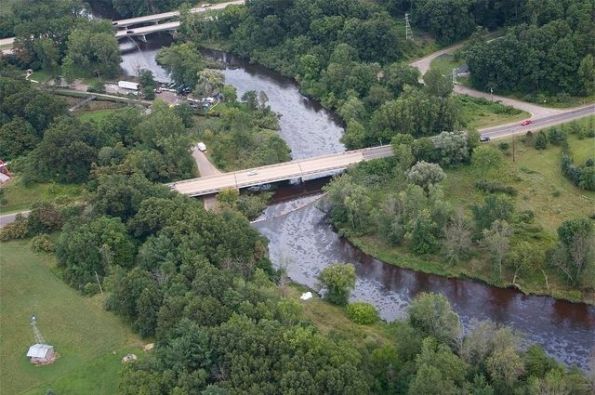
Photograph: State of Michigan
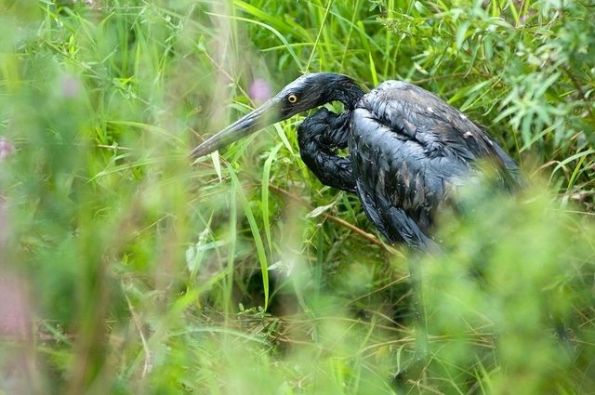
Photograph: State of Michigan
Photograph: State of Michigan
Tomorrow on EG Radio: the Kalamazoo River oil spill

This week on Earthgauge, we’ll take a look back at what happened in Michigan in 2010 when an Enbridge pipeline ruptured spilling roughly 1 million gallons of oil into the Kalamazoo River. What is the legacy of the spill and is there anything for the rest of us to learn as we contemplate the construction of more pipelines from the tar sands of Alberta to B.C. and the Gulf of Mexico?
I was in Kalamazoo and the surrounding area last week and I had the opportunity to speak with residents who have been affected by the spill and its aftermath. First we hear from Susan Connelly, a local resident who was living near the site of the spill when it occurred. Her kids’ daycare was just a half mile away so she’ll tell us about some of the health effects her family and her community suffered following the spill and in the intervening 3 years.
Next we’ll hear from another local resident, Jeff Insko, who started the Line 6B citizen’s blog. After the rupture of the pipeline known as line 6B, Enbridge decided to replace a huge section of pipe through Michigan, some of which runs beneath the property of local residents. Jeff will tell us why he has been less than satisfied in his dealings with Enbridge as they exercised their legal authority to dig up his land and cut down his trees in order to install their new pipe.
We’re also going to get an overview of the incident from Rachel Maddow of MSNBC who did a feature last summer when the US National Transportation Safety Board issued a scathing report about Enbridge’s handling of the spill and their mistakes leading up to it.
Of course we’ll also have our usual update from Kathy of Ecology Ottawa on local environmental events and campaigns. That’s at around 7:50.
Tune in tomorrow!
EG Radio March 28: Federal Budget 2013, urbanization in Kenya and the tar sands “staples” trap
We love covering local stories on Earthgauge and this week, we get just about as local as we can, focusing on some compelling environmental research taking place at Carleton University in Ottawa. We also take a look at the environmental provisions of last week’s federal Budget 2013. We have 3 interviews on today’s show:
- Glennys Egan on the environmental and human impacts of urbanization in Kenya
- Brendan Haley on the tar sands “staples trap”
- Andrew Van Iterson on the environmental measures in Budget 2013
We also have our usual update from Kathy of Ecology Ottawa on local environmental events and campaigns.
Click the audio player above to stream the show or right click here to download.
Part 1 – Budget 2013
Right click here to download.
To kick off the program this week, I speak with Andrew Van Iterson who is the manager of the Green Budget Coalition. Environmental funding in last week’s 2013 federal budget had very little in the way of environmental provisions. Sustainable Development Technology Canada, a government-funded venture capital firm that invests in environmental technology firms, will get $325 million over eight years and there is some funding for municipal projects, notably the City of Ottawa’s new wastewater holding tanks. But the green measures are pretty slim beyond that. The Green Budget Coalition, founded in 1999, brings together sixteen leading Canadian environmental and conservation organizations, which collectively represent over 600,000 Canadians, through our volunteers, members and supporters. They make an annual set of recommendations to the federal government regarding strategic fiscal and budgetary opportunities.
Part 2 – Glennys Egan
Right click here to download.
Next up Earthgauge contributor Juanita Bawagan speaks with Glennys Egan who is a Masters student in the African Studies program at Carleton whose research is based on issues of urbanization in Kenya. She has recently been in Kenya working with a community organization through Street Kids International based in a Nairobi slum and she tells Juanita about her research and experiences there, and the environmental and human impacts of urbanization in Kenya.
Part 3 – Brendan Haley
Right click here to download.
In the second half hour, I speak with Brendan Haley who is a PhD student at Carleton’s School of Public Policy and Administration and a fellow of the Broadbent Institute. He co-authored a recent study called ‘The Bitumen Cliff’ warning that the poorly regulated bitumen industry is creating a double threat to Canada: a so-called “staples trap,” with an economy over-reliant on bitumen exports, and a “carbon trap,” locking Canada into fossil fuels instead of adapting to climate change. The report was co-authored by the Canadian Centre for Policy Alternatives and the Polaris Institute.
Earthgauge Radio airs every Thursday morning at 7:00 AM on CKCU 93.1 FM in Ottawa and online around the world at www.ckcufm.com. Ottawa’s only radio program dedicated exclusively to environmental news and commentary from Ottawa, across the country and around the world. Podcasts on iTunes and right here on earthgauge.ca.
Check out my interview on last week’s Green Majority show on CIUT!
Last week I was interviewed by Daryn Caister of The Green Majority, which is a weekly environmental news program produced live at CIUT in Toronto and broadcast on campus and community stations across the country. During the interview we talked about my visit to Washington, DC for the most recent massive Keystone XL pipeline protest on February 17, 2013 and some larger issues around Keystone and climate change more generally.
You can hear the interview at the following link:
http://greenmajoritymedia.wordpress.com/2013/02/22/tgm-022213/


